
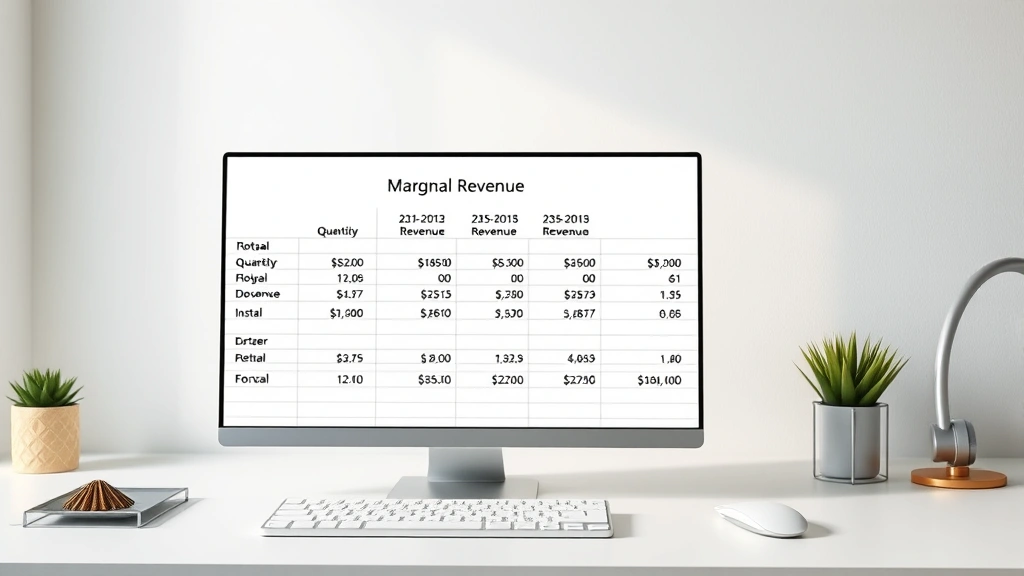
Learning how to work out marginal revenue is one of those skills that looks intimidating until you actually break it down—then it clicks. Whether you’re running a small business, analyzing pricing strategies, or just trying to understand economics better, marginal revenue (MR) is the tool that shows you exactly how much extra cash each additional sale brings in. It’s not as complicated as it sounds, and I’m going to walk you through it step by step.
Table of Contents
What Is Marginal Revenue?
Marginal revenue is the additional income you generate by selling one more unit of product or service. Think of it this way: if you sell 10 units and make $1,000, then sell 11 units and make $1,050, your marginal revenue for that 11th unit is $50. It’s the incremental gain—nothing more, nothing less.
This concept matters because it tells you whether it’s worth producing and selling that next item. In real business, your costs change with volume, and so does your revenue per unit. Understanding MR helps you find the sweet spot where profit is maximized.
Basic Formula Explained
The formula for marginal revenue is straightforward:
Marginal Revenue = Change in Total Revenue ÷ Change in Quantity Sold
Or written more formally:
MR = ΔTR ÷ ΔQ
Where:
- ΔTR = Change in Total Revenue (new revenue minus old revenue)
- ΔQ = Change in Quantity (new quantity minus old quantity)
The delta symbol (Δ) just means “change in.” So you’re calculating how much your total revenue changed divided by how many more units you sold. That’s it. The beauty of this formula is its simplicity—you only need two pieces of data to calculate MR.
Step-by-Step Calculation
Let me walk you through a practical example so you can see exactly how this works:
Your Scenario: You’re selling handmade widgets.
- At 50 units sold: Total revenue = $5,000
- At 51 units sold: Total revenue = $5,045
Step 1: Calculate the change in total revenue
$5,045 – $5,000 = $45
Step 2: Calculate the change in quantity
51 – 50 = 1 unit
Step 3: Divide change in revenue by change in quantity
$45 ÷ 1 = $45
Result: Your marginal revenue is $45 per unit.
This means that 51st widget added $45 to your bottom line. If your costs to produce that widget were less than $45, you made money. If costs were more, you lost money.
Using Excel Spreadsheets
For larger datasets, Excel makes this calculation painless. Here’s how to set it up:

Create three columns:
- Column A: Quantity Sold
- Column B: Total Revenue
- Column C: Marginal Revenue
In Column A, enter your quantities (1, 2, 3, 4, etc.). In Column B, enter corresponding total revenues. Now for Column C, you’ll use a formula.
Starting in cell C2 (skip C1 for the header), enter:
=B2-B1
This calculates the change in revenue. Then divide an Excel cell by the change in quantity. You can use:
=(B2-B1)/(A2-A1)
Copy this formula down for all your data rows. Excel will automatically adjust the cell references, and you’ll have marginal revenue calculated instantly for every quantity level.
If you need to subtract in Excel to prepare your revenue data first, that’s your starting point before building the MR calculation.
Real-World Business Example
Let’s use an actual scenario: a coffee shop analyzing their espresso sales.
Daily Sales Data:
- At 100 cups sold: Revenue = $400
- At 110 cups sold: Revenue = $435
- At 120 cups sold: Revenue = $465
- At 130 cups sold: Revenue = $490
Calculating MR for each increment:
- 100 to 110 cups: ($435 – $400) ÷ (110 – 100) = $35 ÷ 10 = $3.50 per cup
- 110 to 120 cups: ($465 – $435) ÷ (120 – 110) = $30 ÷ 10 = $3.00 per cup
- 120 to 130 cups: ($490 – $465) ÷ (130 – 120) = $25 ÷ 10 = $2.50 per cup
Notice how marginal revenue decreases as volume increases? That’s typical. Why? Because to sell more cups, the shop might need to lower prices or face market saturation. This data tells the owner that selling 10 more cups in the first batch adds $3.50 each, but selling 10 more in the third batch only adds $2.50 each. That’s crucial information for pricing decisions.
Marginal Revenue vs Average
Don’t confuse marginal revenue with average revenue. They’re different animals:
- Average Revenue = Total Revenue ÷ Total Quantity (what you make per unit on average)
- Marginal Revenue = Change in Revenue ÷ Change in Quantity (what you make on the next unit)
Using the coffee shop example: at 130 cups sold with $490 revenue, average revenue is $490 ÷ 130 = $3.77 per cup. But marginal revenue for that last batch was $2.50 per cup. The average tells you historical performance; marginal revenue tells you what the next sale will contribute.
This distinction matters for decision-making. You might have a healthy average revenue, but if marginal revenue is dropping fast, you’re hitting diminishing returns.
Common Mistakes to Avoid
Mistake #1: Using total revenue instead of change in revenue
Don’t divide total revenue by quantity. You need the *change* in revenue, not the whole amount.

Mistake #2: Ignoring production costs
Marginal revenue tells you income, not profit. Always compare MR against marginal cost (the cost to produce that extra unit). If MR < MC, you’re losing money on additional sales.
Mistake #3: Calculating over too large a quantity change
The more units you add between calculations, the less accurate your MR becomes. Ideally, calculate MR for increments of 1 unit, or at least keep increments small and consistent.
Mistake #4: Assuming MR stays constant
In most real scenarios, MR changes with volume. Don’t calculate it once and assume it applies everywhere.
Pricing Strategy Applications
Once you understand how to work out marginal revenue, you can use it to optimize pricing:
Finding Your Price Point: Calculate MR at different price levels. The point where MR equals marginal cost is typically your profit-maximizing price. Above that, you’re leaving money on the table. Below it, you’re losing profit.
Volume Discounts: If offering bulk discounts, calculate the MR for those larger orders. You might find that selling 100 units at a discount generates more MR than selling 50 at full price.
Market Expansion: Planning to enter a new market? Calculate projected MR. If it’s positive and higher than your current MR, expansion makes financial sense.
These applications require accurate data and consistent calculation, which is why many businesses use spreadsheets or accounting software. If you need to share this analysis with stakeholders, open a PDF in Google Docs to collaborate on financial documents, or create an email group in Gmail to distribute reports to your team.
Frequently Asked Questions
What if my marginal revenue is negative?
Negative MR means your total revenue decreased when you sold more units. This happens when you had to cut prices so much to move extra inventory that you actually made less money overall. It’s a signal to stop increasing production or to find ways to maintain prices.
Can marginal revenue be higher than average revenue?
Yes, absolutely. Early in a sales cycle, MR is often higher than average revenue. As you sell more and potentially lower prices, MR typically drops below average. This crossover point is important for business decisions.
How often should I calculate marginal revenue?
That depends on your business. High-volume retailers might calculate weekly. Service-based businesses might calculate monthly. The key is doing it frequently enough to catch trends and make timely pricing adjustments.
Is marginal revenue the same as profit per unit?
No. Marginal revenue is income only. Profit per unit is MR minus marginal cost. Always factor in what that extra unit costs to produce before claiming it’s profit.
What’s the connection between marginal revenue and elasticity?
Elasticity measures how demand changes with price. High elasticity (demand drops significantly with price increases) typically means MR decreases faster as volume grows. Low elasticity means MR stays relatively stable. Understanding both helps you predict how pricing changes affect revenue.
Wrapping Up
Learning how to work out marginal revenue is a practical skill that pays dividends in business decision-making. The formula is simple: change in revenue divided by change in quantity. The applications are powerful: optimizing prices, evaluating expansion, and maximizing profit.
Start with a spreadsheet, gather your sales data, and run the calculations. You’ll quickly see patterns in your business that weren’t obvious before. And remember—marginal revenue is just one piece of the puzzle. Pair it with marginal cost analysis, market research, and good old business intuition, and you’ve got a solid foundation for smart pricing strategies.
For additional resources on financial analysis and documentation, check out Family Handyman for practical business tips, or consult This Old House for resource management strategies. If you’re documenting your financial analysis, Bob Vila offers guidance on detailed project planning that applies to business analysis too.


