

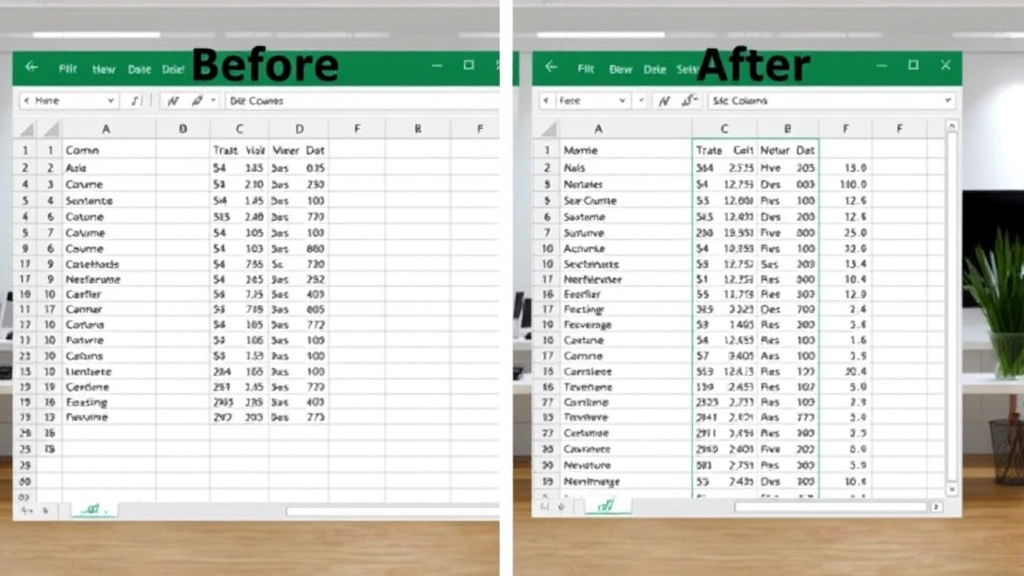
Ever stared at your Excel spreadsheet and thought, “Why is my data in the wrong order?” You’re not alone. Figuring out how to move Excel columns trips up more people than you’d think—and it’s frustrating because it feels like it should be simple. The good news? It is simple once you know the tricks. Whether you’re reorganizing a budget, rearranging client data, or just cleaning up a messy sheet, moving columns in Excel is one of those skills that saves you hours of manual work.
The real struggle isn’t the mechanics—it’s knowing which method works best for your situation. Do you drag and drop? Use cut and paste? Insert a new column and delete the old one? Each approach has its moment, and I’m going to walk you through all of them so you can pick the right one every single time.
The Drag-and-Drop Method (Fastest)
This is the quickest way to move a single column, and it works like you’d expect. Think of it like sliding a book across a shelf—grab it, pull it to where you want it, and let go.
Here’s exactly how to do it:
- Click the column letter at the top (A, B, C, etc.) to select the entire column. You’ll see the whole column highlight in blue.
- Position your cursor at the left or right edge of the selected column until you see a move cursor (looks like a four-way arrow).
- Click and hold, then drag the column to its new location. You’ll see a thick line appear showing where the column will land.
- Release the mouse button. Done.
The drag-and-drop method is fast and intuitive, but here’s the catch: it only works reliably when you’re moving columns within the same sheet and you’re not dealing with formulas that reference those columns. If your spreadsheet has formulas pointing to the old column positions, those formulas will break or adjust in ways you might not expect.
Pro Tip: If you’re nervous about breaking something, use Ctrl+Z immediately after dropping the column. You can undo in a split second if things go sideways. I always keep one hand near the undo button when doing this.
Cut and Paste Method (Most Reliable)
This is the method I recommend for most situations, especially when you’re working with complex spreadsheets. It’s slightly slower than drag-and-drop, but it’s way more predictable and it handles formulas better.
Step-by-step:
- Click the column letter to select the entire column.
- Right-click and choose “Cut” (or press Ctrl+X on Windows, Cmd+X on Mac).
- Click the column letter where you want to insert the cut column. This is important: you’re clicking on the column that will shift to the right to make room.
- Right-click and choose “Insert Cut Cells” (or you can use Ctrl+V and then adjust).
The beauty of this method is that Excel automatically adjusts any formulas that reference the moved column. If you had a formula in column D that said “=SUM(B2:B10)” and you moved column B, Excel will update that formula to reflect the new position. That’s huge when you’re dealing with data-heavy sheets.
According to Family Handyman’s approach to organization, the methodical approach always wins over the quick fix—same logic applies here. Take the extra 10 seconds to do it right.
Insert and Delete Method (When You Need Control)
Sometimes you want absolute control over what happens. This method gives you that. It’s more steps, but it’s bulletproof.
Here’s the process:
- Right-click on the column where you want the moved column to end up.
- Select “Insert Column Before” (or “Insert Column After,” depending on where you want it).
- Go back to the original column (it’s shifted one position now) and cut it.
- Paste it into the newly inserted empty column.
- Delete the original column if it’s now empty or redundant.
This method takes more clicks, but it gives you a safety net. You can see exactly what’s happening at each step, and you can undo any individual step if something feels off. It’s like building a bookshelf one shelf at a time instead of trying to move the whole thing at once.
Moving Multiple Columns at Once

What if you need to move columns B, C, and D all together? Good news—you can select multiple columns and move them as a group.
To select multiple adjacent columns:
- Click on the first column letter (B).
- Hold Shift and click on the last column letter (D). All columns B through D will highlight.
- Now use any of the methods above (drag-and-drop, cut-paste, or insert-delete). They all work with multiple columns selected.
To select non-adjacent columns:
- Click the first column letter.
- Hold Ctrl (or Cmd on Mac) and click each additional column you want to select.
- These columns won’t move together as a block—Excel will move them individually to fill gaps. This is usually not what you want, so stick with adjacent columns unless you have a specific reason.
Real talk: moving multiple columns is where things get tricky. If you have formulas that reference these columns, you need to be extra careful. I usually do a test run first on a copy of the sheet, just to make sure nothing breaks.
Common Mistakes That Mess Everything Up
Mistake #1: Forgetting to select the entire column. If you only select a few cells instead of the whole column, you’ll move just those cells, not the entire column. Always click the column letter to select the whole thing.
Mistake #2: Breaking formulas without realizing it. You move a column, and suddenly your charts go blank or your calculations are wrong. This happens because formulas are still pointing to the old column references. Use the cut-and-paste method to let Excel adjust formulas automatically.
Mistake #3: Not checking for hidden columns. If your spreadsheet has hidden columns (and you can’t see them), moving columns can shift things in unexpected ways. Go to Format > Columns > Unhide to reveal any hidden columns before moving things around.
Mistake #4: Forgetting to save after moving. This sounds obvious, but I’ve seen people spend 20 minutes reorganizing and then accidentally close without saving. Hit Ctrl+S (or Cmd+S) right after you move columns, especially if you’re nervous about the change.
Mistake #5: Moving columns when you should be filtering instead. Sometimes the issue isn’t that your columns are in the wrong order—it’s that you’re looking at too much data at once. Before you start moving things, ask yourself: do I actually need to reorganize, or do I just need to filter or sort?
Advanced Techniques for Complex Sheets
If you’re working with a spreadsheet that has locked cells, merged cells, or complex formulas, moving columns becomes trickier. Here’s how to handle it.
Moving columns with locked cells: If your sheet has protected areas, you might not be able to move columns at all. You’ll need to unprotect the sheet first. Go to Review > Unprotect Sheet, enter the password if there is one, and then move your columns. Lock it again afterward.
Moving columns with merged cells: Merged cells can block column movement. If you try to move a column and Excel won’t let you, it’s probably because a merged cell is in the way. Unmerge the cells (Format > Merge & Center to toggle it off), move your columns, and then re-merge if needed.
Handling formulas that reference moved columns: If you have a formula like “=A1+B1” and you move column B, Excel will update it to “=A1+C1” (assuming B moved one column to the right). But if you have absolute references like “=$B$1”, Excel won’t update them automatically. You might need to manually fix these formulas after moving columns. This is why careful planning matters—think through your formula structure before you start moving things.
Using the Move or Copy dialog: Right-click on a column and select “Move or Copy” to open a dialog that lets you specify exactly where the column should go. This is useful when you’re working with multiple sheets and want to move a column to a different sheet entirely. Just select the destination sheet from the list and choose whether you want to move or copy.
Keyboard Shortcuts That Speed Things Up
If you’re doing this repeatedly, keyboard shortcuts will save you time. Here are the ones that matter:
- Ctrl+X (Cmd+X on Mac): Cut the selected column.
- Ctrl+C (Cmd+C on Mac): Copy the selected column.
- Ctrl+V (Cmd+V on Mac): Paste the column.
- Ctrl+Z (Cmd+Z on Mac): Undo the last action. Use this liberally.
- Shift+Space: Select the entire row. (Not a column move shortcut, but useful for selecting data.)
- Ctrl+Space: Select the entire column. This is faster than clicking the column letter.
Pro move: combine Ctrl+Space with Ctrl+X, then click where you want it, and Ctrl+V. That’s the fastest keyboard-only method for moving columns.
According to Bob Vila’s approach to efficiency, mastering shortcuts is about building muscle memory. Do it a few times and it becomes second nature.
Frequently Asked Questions
Can I move a column to a different Excel sheet?
– Yes, but you’ll need to use cut and paste or the Move or Copy dialog. Cut the column from the first sheet, go to the destination sheet, right-click where you want it, and paste. The column will appear in the new sheet. Note that any formulas referencing that column from the original sheet will break, so you’ll need to update them manually.
What happens to my formulas when I move a column?
– It depends on the method. If you use cut and paste, Excel updates relative references automatically. If you use drag-and-drop, it might not. Absolute references (like $B$1) don’t update automatically either way. Always double-check your formulas after moving columns, especially if you have complex data analysis going on.
Can I undo a column move?
– Absolutely. Press Ctrl+Z (or Cmd+Z on Mac) immediately after moving the column. Excel will restore it to its original position. You can undo multiple times if you need to go back several steps.
Why won’t Excel let me move my column?
– The sheet is probably protected or there’s a merged cell in the way. Check the Review tab to see if the sheet is protected, and look for any merged cells that might be blocking the move. Unprotect the sheet or unmerge the cells, and try again.
Is there a difference between moving and copying a column?
– Yes. Moving removes the column from its original location and places it elsewhere. Copying creates a duplicate in the new location while keeping the original. Use cut (move) when you want to reorganize. Use copy when you want to duplicate data.
How do I move columns in Google Sheets?
– The process is almost identical. Right-click the column letter, select “Move column,” and choose where you want it to go. Or drag and drop just like in Excel. Google Sheets is actually slightly more forgiving with formulas—it updates them more reliably when you move columns.
Can I move a column to the very beginning (before column A)?
– No, column A is always the first column. If you want a column to be first, you’d need to insert a new column before A and then move or copy your data there. It’s a workaround, but it works.


