
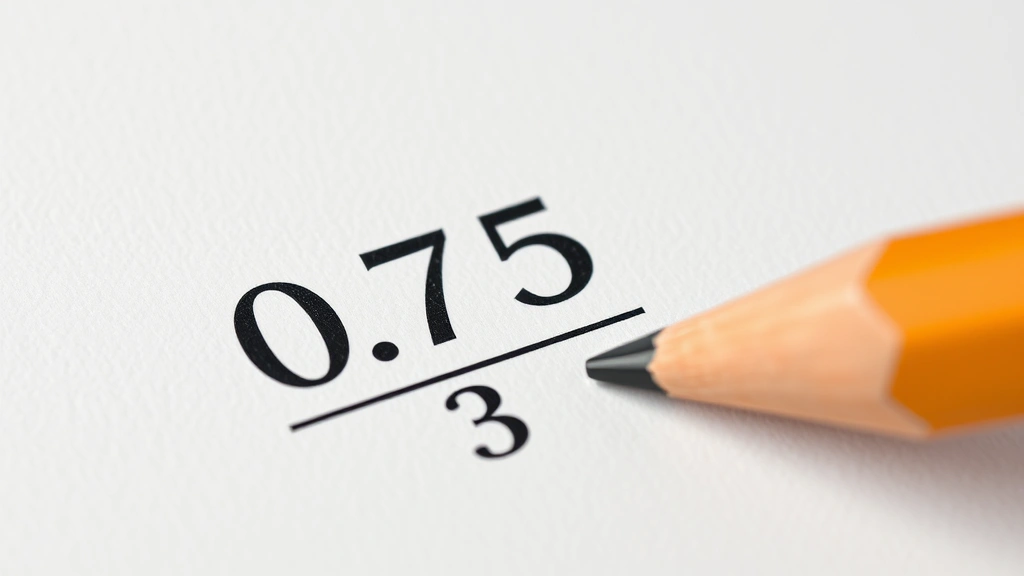
Learning how to change a decimal to a fraction is one of those practical math skills that actually shows up in real life—whether you’re scaling recipes, working with measurements, or dealing with data. The good news? It’s way simpler than you might think, and once you nail the process, you’ll wonder why it ever seemed complicated.
In this guide, I’m going to walk you through the exact steps, show you some practical examples, and give you the confidence to convert any decimal into a fraction without breaking a sweat.
Table of Contents
Why Convert Decimals to Fractions?
Before we dive into the mechanics, let’s talk about why this matters. Decimals and fractions represent the same thing—parts of a whole—but fractions are often clearer and more precise. When you’re baking and a recipe calls for 0.75 cups of flour, saying “three-quarters cup” is instantly more intuitive. In construction and woodworking, measurements like 0.625 inches are way easier to work with when you know that’s 5/8 of an inch.
Plus, if you’re working with spreadsheets or averaging percentages, understanding the relationship between decimals and fractions gives you more flexibility in how you approach calculations. It’s about having more tools in your toolkit.
The Basic Method Explained
Here’s the foundation: every decimal can be converted to a fraction. The process depends on whether you’re dealing with a terminating decimal (one that ends, like 0.5) or a repeating decimal (one that goes on forever, like 0.333…).
For most everyday situations, you’ll be working with terminating decimals. The core principle is simple: the number of decimal places tells you what denominator to use. One decimal place means you divide by 10. Two decimal places mean you divide by 100. Three decimal places mean you divide by 1,000. And so on.
Once you’ve got your fraction set up, you simplify it by finding the greatest common divisor (GCD) of the numerator and denominator. That’s it. That’s the whole game.
Step-by-Step Conversion Process
Let me break this down into actionable steps you can follow every single time:
Step 1: Write the decimal as a fraction with 1 as the denominator. If you’re converting 0.75, you’d write it as 0.75/1.
Step 2: Count the decimal places. In 0.75, there are two decimal places.
Step 3: Multiply both numerator and denominator by 10 for each decimal place. Since there are two decimal places, multiply by 100 (which is 10²). This gives you (0.75 × 100)/(1 × 100) = 75/100.
Step 4: Simplify the fraction. Find the GCD of 75 and 100. Both are divisible by 25, so 75/100 becomes 3/4.
Step 5: Verify your answer. Divide the numerator by the denominator: 3 ÷ 4 = 0.75. Perfect match.
Working with Terminating Decimals
Terminating decimals are your friends because they have a definite end point. Examples include 0.5, 0.25, 0.125, and 0.875. These are the ones you’ll encounter most often in cooking, construction, and general measurements.
The process for terminating decimals is straightforward using the method I outlined above. Let’s walk through another example: converting 0.625.
Count the decimal places: three. Multiply by 1,000 (since 10³ = 1,000): (0.625 × 1,000)/(1 × 1,000) = 625/1,000. Now simplify. Both 625 and 1,000 are divisible by 125: 625/1,000 = 5/8. Check: 5 ÷ 8 = 0.625. Done.

The beauty of terminating decimals is that they always simplify nicely. You’re not going to get stuck with weird fractions that don’t reduce cleanly.
Handling Repeating Decimals
Repeating decimals are trickier, but still manageable. A repeating decimal like 0.333… (which represents one-third) or 0.666… (which represents two-thirds) requires a different approach.
For a simple repeating decimal where the same digit repeats forever, use this formula: if the repeating digit is in the first decimal place, put that digit over 9. So 0.333… becomes 3/9, which simplifies to 1/3. And 0.666… becomes 6/9, which simplifies to 2/3.
For more complex repeating decimals, like 0.142857142857… (which is 1/7), the process is more involved and typically requires algebra. For practical purposes, most everyday conversions involve terminating decimals, so you won’t need to tackle these often.
Simplifying Your Fractions
This is where many people stumble, so let’s make it crystal clear. Simplifying means reducing a fraction to its lowest terms by dividing both the numerator and denominator by their greatest common divisor.
Finding the GCD is easier than it sounds. Start by listing the factors of each number. For 75 and 100: factors of 75 are 1, 3, 5, 15, 25, 75. Factors of 100 are 1, 2, 4, 5, 10, 20, 25, 50, 100. The common factors are 1, 5, and 25. The greatest is 25.
Divide both by 25: 75 ÷ 25 = 3, and 100 ÷ 25 = 4. So 75/100 = 3/4. A quick way to check if you’ve simplified correctly: the numerator and denominator should share no common factors other than 1.
Real-World Examples
Let’s get concrete. Say you’re working with data and need to merge columns in Excel that contain decimal values, and you want to understand what those decimals represent as fractions.
Example 1: Converting 0.5 – One decimal place means divide by 10. Well, actually, 0.5 = 5/10. Simplify by dividing both by 5: 5/10 = 1/2. This one’s intuitive—half.
Example 2: Converting 0.125 – Three decimal places mean divide by 1,000. So 0.125 = 125/1,000. Find the GCD (125). Divide: 125/1,000 = 1/8. Useful for measurements in inches.
Example 3: Converting 0.2 – One decimal place means divide by 10. So 0.2 = 2/10. Simplify by dividing both by 2: 2/10 = 1/5.
If you’re dealing with percentages and need to understand their fractional equivalents, check out our guide on averaging percentages for context on how these conversions fit into larger calculations.
Avoiding Common Mistakes
The most common mistake? Forgetting to simplify. Converting 0.5 to 5/10 and stopping there is technically correct, but it’s not the proper final answer. Always reduce to the simplest form.
Another frequent error is miscounting decimal places. If you’re converting 0.0625, that’s four decimal places, not three. Multiply by 10,000, not 1,000. Getting this wrong throws off your entire calculation.
A third pitfall: assuming all decimals convert to “nice” fractions. Some don’t—and that’s okay. If you get something like 17/47, that’s a valid answer even if it’s not a common fraction you recognize.
Finally, don’t skip the verification step. After you convert and simplify, divide the numerator by the denominator to confirm you get back your original decimal. This takes 10 seconds and saves you from carrying forward errors.
Quick Reference Chart
Here are some common decimal-to-fraction conversions you’ll see repeatedly:
Common Conversions:
0.5 = 1/2
0.25 = 1/4
0.75 = 3/4
0.125 = 1/8
0.375 = 3/8
0.625 = 5/8
0.875 = 7/8
0.2 = 1/5
0.4 = 2/5
0.6 = 3/5
0.8 = 4/5
0.333… = 1/3
0.666… = 2/3
Memorizing these common ones saves you time on everyday tasks. If you’re working with data in spreadsheets and need to lock row in Excel while you reference this chart, that’s a smart workflow.
Frequently Asked Questions
Can all decimals be converted to fractions?
Yes, every decimal can be expressed as a fraction. Terminating decimals convert cleanly, and repeating decimals also have fractional equivalents (like 0.333… = 1/3). Non-repeating, non-terminating decimals (like pi) technically can’t be expressed as simple fractions, but those are special cases you won’t encounter in everyday conversions.
What’s the difference between a terminating and repeating decimal?
A terminating decimal ends, like 0.75 or 0.125. A repeating decimal continues infinitely with a pattern, like 0.333… or 0.142857142857…. Terminating decimals are easier to convert and are more common in practical applications.
Do I always have to simplify the fraction?
Technically, 75/100 and 3/4 are the same value. However, simplified fractions are considered the “correct” final answer in most contexts. It’s cleaner, easier to work with, and shows you understand the concept fully.
How do I know if I’ve simplified correctly?
Your numerator and denominator should share no common factors except 1. You can verify this by checking if either number divides evenly into the other. If they don’t, you’re done.
What if the decimal has a lot of places?
The method stays the same. If you have 0.123456, that’s six decimal places, so multiply by 1,000,000 to get 123456/1,000,000. Then simplify. It’s more tedious, but the principle is identical.
Are there shortcuts for common decimals?
Absolutely. If you memorize the common conversions I listed in the reference chart, you’ll recognize them instantly. For decimals that are multiples of those (like 0.5 is 1/2, so 1.5 is 3/2), you can apply quick mental math.
Wrapping It Up
Converting decimals to fractions isn’t rocket science—it’s a straightforward process that becomes second nature with practice. Count your decimal places, set up your fraction, simplify, and verify. That’s the whole framework.
Whether you’re scaling a recipe, measuring materials, or just trying to understand data better, this skill makes you more confident and capable. Start with the common conversions, practice the step-by-step method, and soon you’ll be converting decimals without thinking about it. And if you ever need to reference the exact steps again, you know where to find them.


