
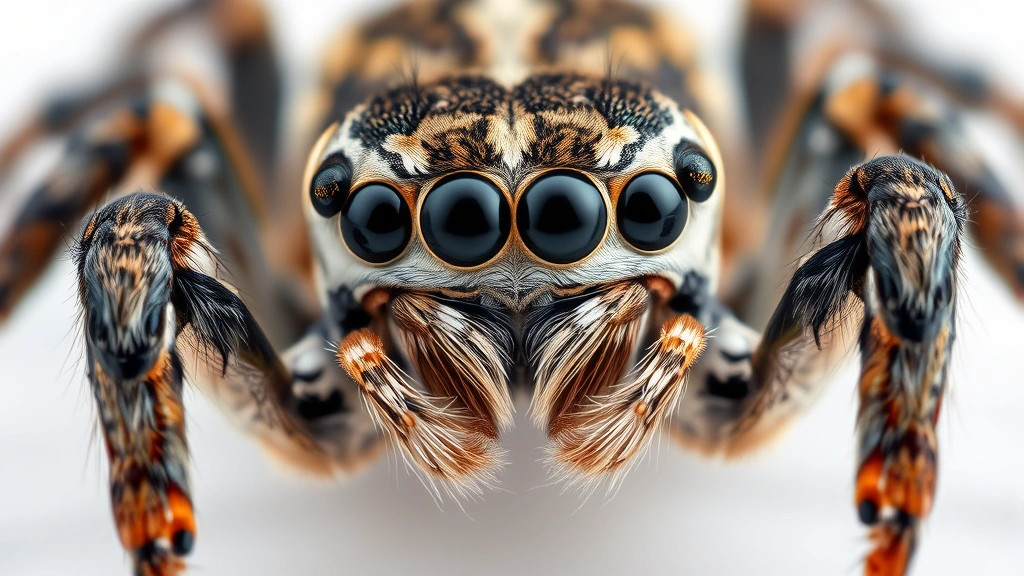
So you’re wondering how many eyes do spiders have? The short answer might surprise you: most spiders have eight eyes, but some have six, two, or even zero. That’s right—not all spiders see the world the same way, and understanding spider vision is way more fascinating than you’d think. Whether you’re curious about these eight-legged creatures for pest control, photography, or just plain curiosity, we’re breaking down everything you need to know about spider eyes and how they actually work.
Table of Contents
Eight Eyes: The Standard Setup
Let’s get straight to it—about 99% of spiders have eight eyes arranged in different patterns depending on the species. Think of it like having security cameras positioned all around a building. Each eye serves a specific purpose, and the arrangement tells you a lot about how that spider hunts and survives. Some spiders have their eight eyes arranged in two rows, others in a circle, and some in patterns that look almost random at first glance.
The eight-eye configuration isn’t random at all. It’s the result of millions of years of evolution fine-tuning spider vision for survival. Unlike humans with two forward-facing eyes, spiders use their multiple eyes to detect movement from nearly every direction. This is crucial when you’re a tiny creature that’s both predator and prey. Your eyes are your early warning system, and having eight of them beats having two any day of the week.
Why Multiple Eyes Matter for Hunting
Here’s where it gets interesting: spider eyes aren’t all created equal. Most spiders have a pair of large principal eyes (the main ones) and several pairs of smaller secondary eyes. The principal eyes usually provide the detailed vision, while the secondary eyes are motion detectors. It’s like having a high-definition camera paired with motion sensors—you get detail where you need it and awareness of movement everywhere else.
This setup is perfect for hunting. A jumping spider, for example, uses its large forward-facing principal eyes to focus on prey with incredible detail, while its side eyes detect when something moves nearby. It’s a system that’s been battle-tested for millions of years, and it works incredibly well. When you’re a predator that relies on speed and accuracy, having multiple eyes watching different zones gives you a massive advantage.
Different Eye Types Explained
Spider eyes fall into two main categories: simple eyes (ocelli) and compound eyes. Most spiders have simple eyes, which work somewhat like a camera with a single lens. Each eye is independent and sends its own signal to the spider’s brain. This is different from insect compound eyes, which have thousands of tiny lenses working together.
The principal eyes in many spiders are actually quite sophisticated. Jumping spiders, for instance, have principal eyes with a lens system that provides incredibly sharp vision—comparable to human vision in some ways. Their secondary eyes, meanwhile, are simpler and mainly detect movement and light changes. This combination is what makes jumping spiders such effective hunters. They can spot a fly from across a room and calculate the exact distance to jump with precision.
Some hunting spiders, like wolf spiders, have a different arrangement. They’ve got larger secondary eyes positioned to the sides and rear, giving them nearly 360-degree awareness. Their principal eyes aren’t as powerful as a jumping spider’s, but they don’t need to be. Wolf spiders hunt by chasing down prey, and their wide field of view is more valuable than extreme detail.
Jumping Spiders Have Superpowers
If you want to see spider vision at its finest, look at jumping spiders. These little hunters have the best vision in the spider world. Their principal eyes are massive relative to their head size and can see in color—something most spiders can’t do. They can distinguish between different wavelengths of light and see ultraviolet patterns on flowers and prey that are invisible to humans.
What really blows people away is their depth perception. Jumping spiders can judge distance with remarkable accuracy, which is essential when you’re going to launch yourself at prey from several inches away. They use a technique called parallax vision, moving their head slightly to calculate how far away something is. Watch a jumping spider stalk prey, and you’ll see it bob its head back and forth—that’s it measuring distance before the pounce.
The vision quality of jumping spiders is so good that researchers have studied their eyes extensively. They’ve got a focusing system similar to camera autofocus, and they can see details that would require a magnifying glass for humans to observe. If you ever get the chance to watch a jumping spider hunt, take it. You’re watching one of nature’s most efficient visual predators in action.
How Hunting Spiders Actually See
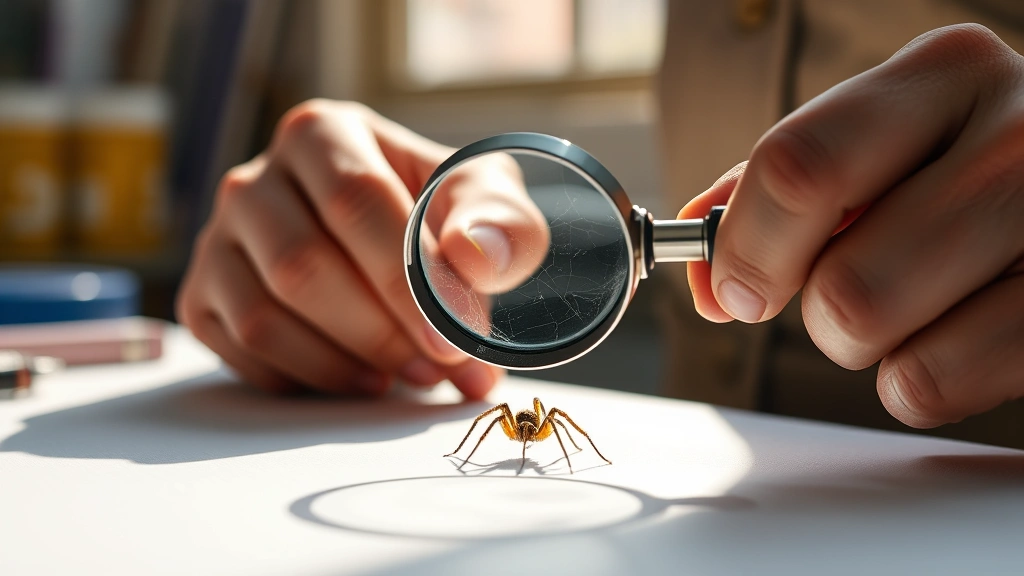
Wolf spiders and other active hunters have a different visual strategy than jumping spiders. They rely more on motion detection than detail vision. Their eyes are positioned to give them a wide field of view—some wolf spiders can see nearly 360 degrees around their body. This makes sense when your hunting strategy involves chasing down prey at night.
Wolf spiders are nocturnal hunters, so their eyes have adapted for low-light conditions. They have a reflective layer behind their retinas called a tapetum lucidum, which bounces light back through the photoreceptors. This is the same thing that makes a cat’s eyes glow in the dark. It gives them better night vision, which is essential when you’re hunting in dim conditions. You’ll often see wolf spiders at night because that’s when their vision advantage is greatest.
The arrangement of their eight eyes is telling. They typically have two large eyes in the front row and six smaller eyes arranged around their head. This setup prioritizes motion detection and peripheral awareness over detailed central vision. It’s a trade-off, but it’s the right one for their hunting style. When you’re chasing down prey that’s trying to escape, you need to see movement everywhere.
Web Builders See Differently
Orb-weaver spiders and other web builders have completely different visual needs than active hunters. Many of them have relatively poor vision because they don’t need it. They rely on vibrations in their web to detect prey, not visual hunting. Their eight eyes are often small and positioned around their head, but they’re not doing the heavy lifting that a hunter’s eyes do.
This is actually a perfect example of evolution matching form to function. A web-building spider doesn’t need high-definition vision because it’s not chasing anything. It’s sitting still, waiting for prey to blunder into its web. When something hits the web, the spider feels the vibrations immediately. The eyes are almost secondary—they might help the spider navigate to find good web-building spots, but they’re not essential for hunting.
Some web-building spiders have evolved to have even fewer eyes or reduced eye function because they simply don’t need them. Their nervous system is optimized for detecting vibrations, and their brain power is dedicated to processing those signals. It’s a reminder that evolution doesn’t waste energy on features that aren’t needed. If you don’t need to see, your body won’t invest in expensive eye tissue.
Rare Exceptions and Oddities
Now here’s where it gets weird. Not all spiders have eight eyes. Some spiders have six eyes, and a few species have even fewer. The Mediterranean recluse spider has six eyes instead of eight. Some cave-dwelling spiders have lost their eyes entirely because they live in complete darkness where vision is useless.
These exceptions are rare, but they show how flexible spider evolution can be. When environmental pressures change, spider bodies adapt. A spider living in a cave where no light ever reaches has no need for eyes, so over generations, those eyes shrink and eventually disappear. The energy that would go into maintaining useless eyes gets redirected elsewhere. It’s efficient and elegant.
There are also spiders that have eye reduction as a normal part of their life cycle. Some spiders are born with more eyes and lose them as they mature. Others have eyes that degenerate over time. These variations are uncommon, but they remind us that the eight-eye standard isn’t absolute—it’s just what works best for most spiders in most situations.
Vision Range and Color Perception
The vision range of spiders varies wildly depending on the species. Jumping spiders can see clearly from several feet away. Wolf spiders have excellent motion detection but less detailed vision. Web-building spiders might only be able to detect light and shadow. It all depends on what that spider needs to survive.
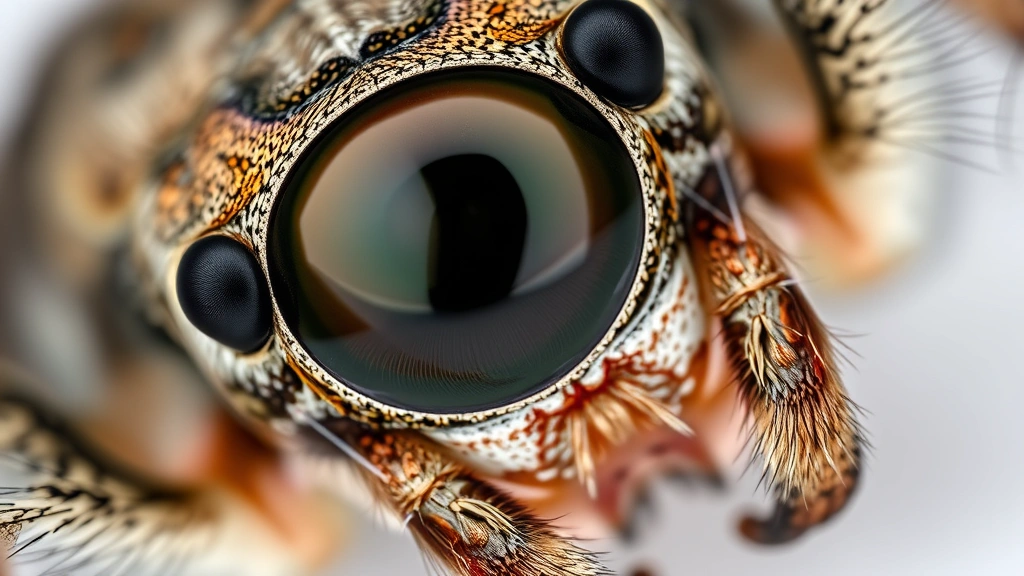
Color perception is another variable. Most spiders see the world in grayscale or limited color. They’re not seeing the vibrant reds and blues that humans see. However, jumping spiders are an exception—they can see in color, including ultraviolet light that’s invisible to humans. This gives them an advantage in spotting prey and communicating with other spiders through color patterns.
The way spiders process visual information is also different from humans. Their brains are tiny, but they’re incredibly efficient at processing motion and calculating distances. A jumping spider’s brain is smaller than a grain of rice, yet it can perform visual calculations that would require sophisticated computer algorithms. Nature has optimized spider vision for speed and accuracy, not for the kind of detailed color vision that humans enjoy.
Frequently Asked Questions
Do all spiders have eight eyes?
Most spiders have eight eyes, but not all. Some species have six eyes, and a few have fewer or none at all. The eight-eye configuration is standard because it provides the best combination of vision for hunting, awareness, and survival. But evolution has created exceptions when environmental pressures demand it.
Can spiders see in color?
Most spiders see in black and white or very limited color. However, jumping spiders are an exception—they have excellent color vision, including the ability to see ultraviolet light. This gives them an advantage in hunting and in recognizing other spiders. It’s one of the reasons jumping spiders are so successful as predators.
How far can spiders see?
Vision range depends on the species. Jumping spiders can see clearly from several feet away. Wolf spiders have good motion detection but less detailed vision at distance. Web-building spiders often have poor vision and rely more on vibrations in their web. Some cave spiders can’t see at all.
Why do spiders need so many eyes?
Multiple eyes give spiders several advantages. They provide a wider field of view, better motion detection, and redundancy if one eye gets damaged. The arrangement of principal and secondary eyes allows spiders to combine detailed vision with motion awareness. This combination makes them effective hunters.
Do spider eyes have pupils?
Spider eyes don’t have pupils like human eyes do. They have fixed apertures, which means they can’t adjust the amount of light entering the eye. This is why some spiders have a reflective layer behind their retinas to help them see better in low light. It’s a different solution to the same problem humans solve with pupils.
Can spiders see humans?
Most spiders can see humans, but not the way you might think. They detect movement and size, but they probably don’t see you as a clear, detailed image like you see them. To a spider, you’re a large moving object. Some spiders might be curious about you, while others will run away. It depends on the species and the situation.
Wrapping It Up
So how many eyes do spiders have? The answer is usually eight, but the real story is way more interesting than just counting eyeballs. Spider vision is a masterpiece of evolutionary engineering, with different species developing completely different visual systems based on their hunting strategies and environments. From the incredible color vision of jumping spiders to the motion-detecting prowess of wolf spiders to the vibration-sensing web builders that barely need eyes at all, spiders have solved the vision problem in dozens of different ways.
Understanding spider eyes helps you appreciate these creatures for what they really are: highly specialized predators with sensory systems fine-tuned for survival. The next time you see a spider, take a moment to think about what it’s seeing. That little wolf spider hunting at night is seeing movement you can’t detect. That jumping spider stalking a fly is calculating distance and speed with precision. And that orb weaver sitting in its web is feeling vibrations through silk threads, barely using its eyes at all. Spider vision isn’t just about eyes—it’s about how evolution builds perfect tools for perfect jobs.


