
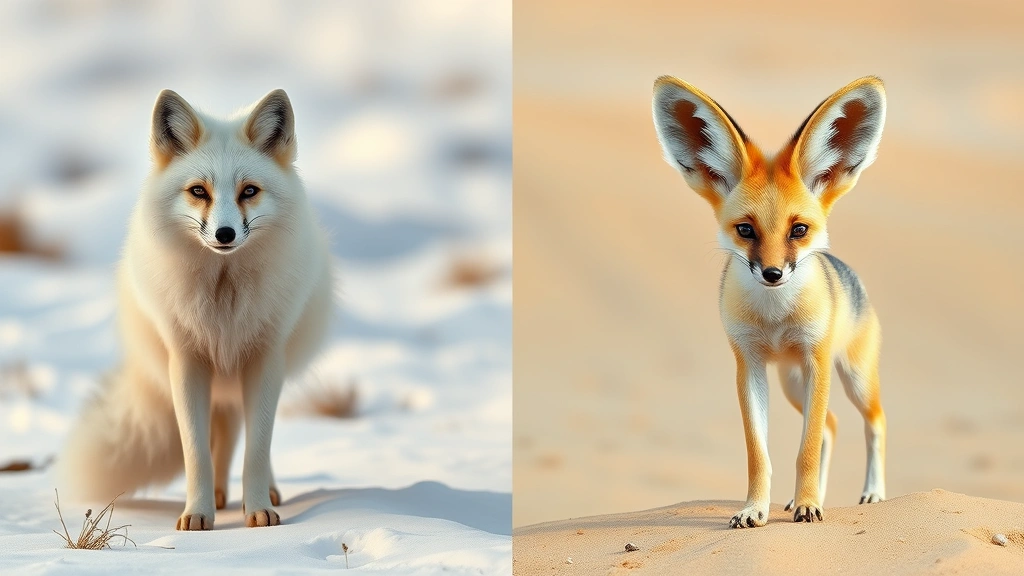
Knowing how big are arctic foxes compared to fennec foxes reveals two fascinating extremes of the fox world—one built for frozen tundras, the other for scorching deserts. If you’ve ever wondered why these two species look so wildly different, size is where the story really begins, and it’s more dramatic than you might expect.
Table of Contents
The Size Difference Overview
When you stack these two foxes side by side, the contrast is almost comical. An arctic fox typically weighs between 6 to 10 pounds, while a fennec fox rarely exceeds 3.5 pounds. That’s roughly three times heavier for the arctic species. But it’s not just about weight—it’s the entire body structure that tells the story of adaptation. The arctic fox evolved to survive brutally cold environments where larger body mass means better heat retention. The fennec fox, meanwhile, developed as a miniature heat-dissipating machine built for the Sahara Desert.
Think of it like comparing a winter coat designed for a blizzard versus one engineered for a hot day. Both are foxes, but their blueprints couldn’t be more different.
Arctic Fox Dimensions Explained
Arctic foxes are built like compact powerhouses. An adult arctic fox measures roughly 18 to 26 inches in body length alone, with their tail adding another 12 to 16 inches of fluffy insulation. Their shoulder height typically reaches 9 to 12 inches. Picture a small dog—maybe the size of a large house cat, but stockier and more muscular.
The head is proportionally smaller compared to their body, with a shorter snout than red foxes. Their legs are shorter and thicker, designed for trudging through snow rather than sprinting across open ground. The paws are heavily furred, almost like built-in snowshoes, which distributes their weight better on frozen terrain. This whole package—compact, dense, heavily furred—screams cold-weather engineering.
Fennec Fox Tiny Frame
Now flip the script completely. A fennec fox’s body length ranges from just 9 to 16 inches, with a tail that’s almost as long as their body at 7 to 12 inches. They stand a mere 8 inches tall at the shoulder. Imagine holding a small rabbit—that’s roughly the size you’re dealing with here. Some fennec foxes barely reach 2 pounds, making them one of the smallest canids on the planet.
What makes fennecs visually distinctive isn’t just their tiny frame—it’s those enormous ears. Their ears can be 4 to 6 inches long, which is absolutely massive relative to their head size. That’s roughly 20% of their entire body length dedicated to ears. Those aren’t just for show; they’re heat radiators that help the fox shed excess body temperature in the desert heat. Their legs are thin and spindly, built for jumping and navigating sandy terrain rather than trudging through snow.
Weight Comparison Breakdown
Let’s get specific with the numbers because they’re genuinely striking:
Arctic Fox Weight Range: 6 to 10 pounds (2.7 to 4.5 kg), with some northern populations reaching up to 12 pounds during winter when they bulk up.
Fennec Fox Weight Range: 1.5 to 3.5 pounds (0.7 to 1.6 kg), averaging around 2.2 pounds.
That means an average arctic fox outweighs an average fennec fox by roughly 300 to 400%. Put another way, you’d need about four fennec foxes to equal the weight of one arctic fox. This isn’t a minor difference—it’s a fundamental divergence in how these animals approach survival.
The weight difference correlates directly with their metabolic needs and hunting strategies. Arctic foxes hunt larger prey like lemmings and birds, requiring more muscle and body mass. Fennecs hunt tiny insects, spiders, and small rodents, where a lightweight frame is actually an advantage for agility and energy efficiency in a food-scarce environment.
Body Length Head to Tail
Here’s where the full picture emerges. When you measure from the tip of the nose to the end of the tail:

Arctic Fox Total Length: 30 to 42 inches (76 to 107 cm). That’s roughly the length of a medium-sized ruler plus a bit more.
Fennec Fox Total Length: 16 to 28 inches (41 to 71 cm). Some individuals are barely longer than a standard ruler.
The tail contributes significantly to these measurements. Arctic foxes use their thick, fluffy tails as blankets—they’ll wrap them around themselves to conserve heat during extreme cold. Fennec tails are thinner and serve more as a balance tool for jumping and quick directional changes on sand.
Ear Size and Adaptation
This is where the comparison gets really interesting because ear size tells you everything about their environment. Arctic foxes have relatively small, rounded ears—sometimes almost hidden in their thick winter fur. This minimizes heat loss through the ears, which is critical in temperatures that can drop to -50°F.
Fennec foxes have ears that are almost absurdly large relative to their body. Those 4 to 6-inch ears are packed with blood vessels that radiate heat away from the body. In desert temperatures exceeding 120°F, this is a survival advantage. They can even hear insects moving underground, which is a hunting advantage in their sparse environment.
If you were designing a fox from scratch, you’d understand: cold environments demand small ears, hot environments demand large ones. Nature got this exactly right for both species.
Evolutionary Reasons for Size
The size difference between these foxes isn’t random—it’s the result of millions of years of natural selection. Arctic foxes evolved larger bodies because of Bergmann’s Rule, which states that animals in colder climates tend to be larger to conserve heat more efficiently. A larger body has less surface area relative to volume, which means less heat loss.
Fennec foxes evolved smaller bodies for the opposite reason. In the Sahara Desert, a smaller body generates less metabolic heat, which means less need to cool down. They also require less food overall, which is crucial when you’re hunting tiny insects in a sparse landscape. Their size is an adaptation to scarcity.
Think of it as opposite solutions to opposite problems. The arctic needed bulk; the desert needed efficiency.
Practical Survival Implications
Size affects everything about how these foxes survive. Arctic foxes can hunt larger prey—lemmings, hares, birds—because they have the body mass and strength to subdue them. They can also store fat reserves during abundant seasons to survive lean winters. Their larger size means they can travel longer distances across frozen terrain without exhaustion.
Fennec foxes, conversely, are built for stealth and precision. They can fit into tiny burrows where predators can’t follow. Their lightweight frame lets them jump up to 10 feet vertically to catch insects mid-air. They require less water because their smaller bodies don’t generate as much metabolic heat. In their environment, being tiny is an advantage, not a limitation.
Visual Size Reference Guide
To really grasp the difference, here are some relatable comparisons:
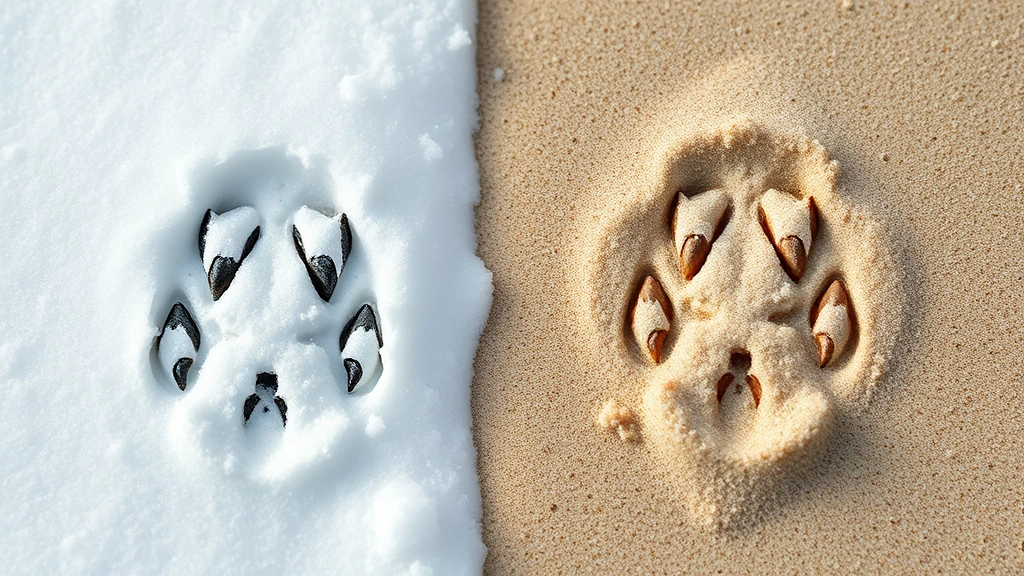
Arctic Fox Size Equivalents: Similar in overall size to a house cat or small rabbit, but denser and more muscular. Imagine a corgi or dachshund dog breed—roughly comparable body length and weight.
Fennec Fox Size Equivalents: Smaller than a house cat, more like a large squirrel or small guinea pig. You could hold an adult fennec fox in both hands comfortably.
If you lined them up, the arctic fox would look like a normal small predator. The fennec fox would look like a toy version of a fox—which is exactly what it is, evolutionarily speaking. It’s a miniaturized fox optimized for a completely different world.
Frequently Asked Questions
Can arctic foxes and fennec foxes interbreed?
No. Despite both being foxes, they’re different species (Vulpes lagopus vs. Vulpes zerda) with significant genetic differences. Their size difference alone would make reproduction physically impossible. They’re about as distantly related within the fox family as a house cat is to a tiger.
Which fox is faster despite the size difference?
Fennec foxes are faster relative to their body size and can reach speeds of 30 mph in short bursts. Arctic foxes top out around 31 mph but need more distance to build speed. For agility and acceleration, the fennec wins; for sustained speed, the arctic fox has the edge.
How do their lifespans compare?
In the wild, both live 8 to 10 years on average. In captivity, arctic foxes can reach 14 years while fennecs sometimes hit 15. Size doesn’t significantly impact lifespan in these species.
Which fox would win in a fight?
The arctic fox would dominate due to sheer size and strength. But fennec foxes are rarely in direct conflict with other predators—they rely on avoidance and hiding instead. It’s not a fair comparison because they evolved different survival strategies.
Are there size variations within each species?
Yes. Arctic foxes in northern populations tend to be larger than southern populations. Fennec foxes show less variation, but desert populations can differ slightly based on food availability. Seasonal weight changes are significant too—arctic foxes can gain 50% of their body weight in winter.
Conclusion Summary
Understanding how big are arctic foxes compared to fennec foxes is really about understanding how evolution sculpts animals for their environments. Arctic foxes, weighing 6 to 10 pounds and measuring 30 to 42 inches total length, are built for cold, scarcity, and long-distance survival. Fennec foxes, weighing 1.5 to 3.5 pounds and measuring 16 to 28 inches total length, are engineered for heat dissipation, agility, and efficient hunting in sparse deserts.
The arctic fox is roughly three times heavier and significantly longer. But “bigger” doesn’t mean “better”—each size is perfectly optimized for its world. If you dropped an arctic fox in the Sahara, it would overheat and starve. Drop a fennec fox in the Arctic, and it would freeze and starve. They’re not just different sizes; they’re different solutions to different problems, shaped by millions of years of living in opposite corners of the planet.
For more wildlife comparisons and animal biology insights, check out resources from the U.S. Fish and Wildlife Service, which provides detailed species information and conservation data. You can also explore Smithsonian Magazine’s wildlife section for in-depth animal research, and National Geographic for stunning photography and scientific articles about arctic and desert ecosystems.


