
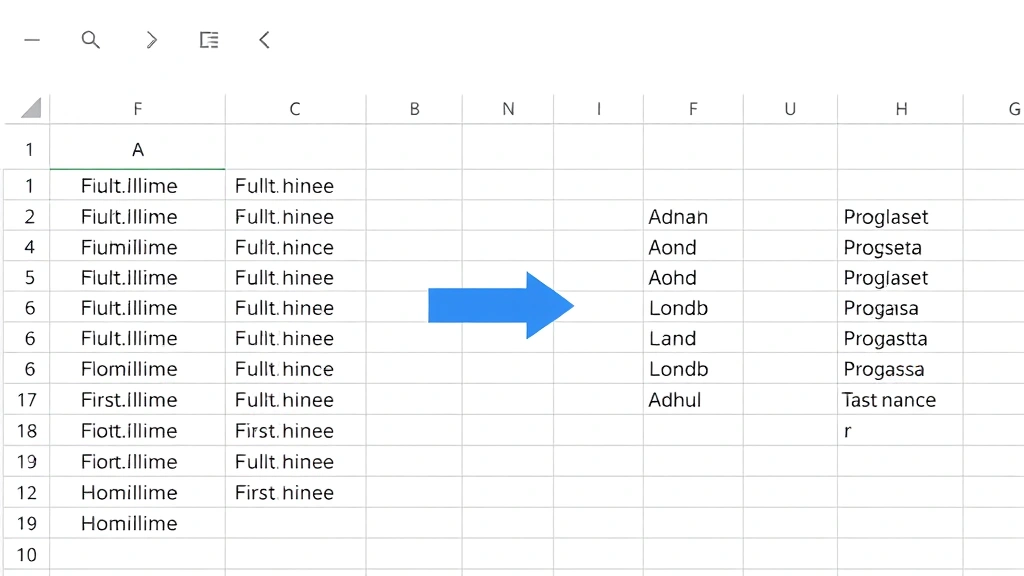
You’ve got a spreadsheet full of names like “John Smith” or “Jane Doe” crammed into a single column, and now you need them split into first and last names. Sound familiar? This is one of those tasks that looks simple until you’re staring at 500 rows wondering if there’s a faster way than manually typing each one. Spoiler: there absolutely is.
Separating names in Excel isn’t just a nice-to-have skill—it’s essential when you’re working with customer lists, employee records, or imported data. The good news? Excel gives you multiple ways to how to separate names in excel, from simple formulas to built-in tools that do the heavy lifting for you. Whether you’re dealing with a handful of names or thousands, you’ll find a method that fits your situation.
Using Text to Columns (The Fastest Way)
If you want to separate names in Excel with zero formulas and maximum speed, Text to Columns is your answer. This feature treats spaces (or any character you choose) as a dividing line, splitting your data across multiple columns instantly.
Here’s the step-by-step process:
- Select the entire column containing the full names. Click the column header to grab the whole thing—don’t mess around selecting individual cells.
- Go to the Data menu at the top of your ribbon.
- Click Text to Columns. A wizard window will pop up.
- In the first step, choose Delimited (not Fixed Width) and click Next.
- On the second screen, uncheck everything except Space. This tells Excel that spaces are your separator.
- Click Next again. You’ll see a preview of how your data will split.
- Choose where you want the split data to land. If you want it in the same location (replacing the original), that’s fine—Excel will overwrite. If you want to keep the original, pick a different starting column.
- Click Finish. Done.
Real talk: Text to Columns is fast, but it’s destructive if you’re not careful. Once you hit Finish, the original data in that column gets replaced. If you need to keep the original names, copy that column to a new spot first, then run Text to Columns on the copy.
Pro Tip: Text to Columns works best with simple “First Last” formats. If you’ve got middle names, suffixes (Jr., Sr.), or inconsistent spacing, you’ll need the formula approach below.
Using Formulas to Split Names
Formulas give you more control and let you keep the original data intact. The downside? They take a bit longer to set up, but once you build them, you can copy them down to hundreds of rows in seconds.
For extracting the first name:
Use the LEFT and FIND functions together. The formula looks like this:
=LEFT(A2,FIND(" ",A2)-1)
What this does: It finds the space character in cell A2, then grabs everything to the left of it. The “-1” removes the space itself.
For extracting the last name:
Use the RIGHT and FIND functions:
=RIGHT(A2,LEN(A2)-FIND(" ",A2))
This finds the space, measures how many characters come after it, and extracts all of them.
How to use these formulas:
- In column B (next to your names), paste the first name formula into cell B2.
- In column C, paste the last name formula into cell C2.
- Press Enter on both. You’ll see the first and last names split out correctly.
- Select cells B2 and C2 together (both cells with formulas).
- Grab the small square at the bottom-right corner of the selection (the fill handle) and drag it down as far as your data goes. Excel will copy the formulas automatically.
The beauty of this approach? If you need to update the original names later, the split names update automatically. Plus, you’re not destroying any data.
Safety Warning: If you use formulas and then delete the original name column, your formulas break and show #REF! errors. If you want to delete the original, first convert the formulas to values by copying them, then using Paste Special > Values.
Power Query Method (For Advanced Users)
Power Query is Excel’s heavy-duty data tool. It’s overkill for simple name splitting, but if you’re importing data regularly or dealing with messy formats, it’s worth learning.
Here’s the basic approach:
- Select your data and go to Data > From Table/Range (or Get & Transform Data depending on your Excel version).
- Power Query opens with your data loaded.
- Right-click the column header with the names and choose Split Column > By Delimiter.
- Select Space as the delimiter.
- Choose whether you want the split columns to replace the original or be added as new columns.
- Click OK, then click Close & Load to send the results back to your spreadsheet.
Power Query is more robust than formulas for weird data, but it has a steeper learning curve. If you’re just doing this once, stick with Text to Columns or formulas. If you’re building a repeatable process, Power Query is your friend.
Find & Replace Technique

This is a sneaky workaround that works when you want to convert spaces into something else (like a line break or a special character) that Excel can use to split columns. It’s not the most direct method, but it’s useful in specific situations.
- Copy your name column to a new location (safety first).
- Open Find & Replace (Ctrl+H).
- In the “Find what” field, type a single space.
- In the “Replace with” field, type a special character like a pipe (|) or tab.
- Click Replace All.
- Now use Text to Columns with your new character as the delimiter.
This sounds roundabout, but it’s useful when spaces in your data are inconsistent or when you need to preserve the original column for other reasons.
Handling Tricky Name Formats
What if names have middle names?
If your data is “John Michael Smith,” a simple space-based split gives you three columns: John, Michael, Smith. If you only want first and last, use a more complex formula that counts from the right:
=RIGHT(A2,LEN(A2)-FIND(" ",A2,FIND(" ",A2)+1))
This finds the second space and extracts everything after it. Combine it with the simple LEFT formula for first names, and you’re golden.
What about suffixes like “Jr.” or “III”?
These are a pain because they’re sometimes in the last name field, sometimes separate. Your best bet is to manually review the data after splitting and clean up as needed. Or use a formula to find and isolate these patterns.
Names with no space (single names)?
Text to Columns will skip these entirely—they’ll stay in the first column. Formulas will throw an error (#VALUE!). You’ll need to manually handle these, or add a conditional formula that checks for the space first:
=IF(ISERROR(FIND(" ",A2)),A2,LEFT(A2,FIND(" ",A2)-1))
This says: “If there’s no space, just return the whole name. If there is a space, extract the first part.”
Names with leading or trailing spaces?
Use the TRIM function to clean these up first:
=TRIM(A2)
Run this in a helper column, then use Text to Columns or your other method on the trimmed data.
Cleaning Up After Separation
Once you’ve split your names, you’ll probably want to clean things up. Here’s what usually needs attention:
Capitalization issues: Sometimes imported data is all caps or all lowercase. Use the PROPER function to fix this:
=PROPER(B2)
This capitalizes the first letter of each word.
Extra spaces: If your split created columns with leading or trailing spaces, TRIM fixes that too.
Organizing your columns: After splitting, you might want to move columns around to match your preferred order. You can also freeze a row to keep headers visible while you scroll.
Removing the original column: Once you’ve verified the split worked correctly, delete the original full-name column. But remember: if you used formulas, convert them to values first (Ctrl+C, then Paste Special > Values).
For more detailed guidance on data organization after splitting, resources like Family Handyman (though focused on home projects) demonstrate similar step-by-step cleanup principles that apply to data work.
Frequently Asked Questions
Can I separate names without losing the original data?
– Yes. Use formulas in new columns, or copy your name column to a new location before using Text to Columns. Text to Columns overwrites the original data, so always protect yourself by working on a copy.
What’s the difference between Text to Columns and formulas?
– Text to Columns is faster for one-time jobs but destructive. Formulas are slower to set up but non-destructive and update automatically if the source data changes. For large datasets, Text to Columns is usually better. For ongoing work, formulas win.
How do I handle names with multiple spaces between first and last?
– Use TRIM first to clean up extra spaces, then apply your splitting method. TRIM removes all extra spaces, leaving just one between words.
Can I separate names by a character other than a space?
– Absolutely. In Text to Columns, you can choose any delimiter: comma, tab, pipe, hyphen, whatever. With formulas, adjust the FIND function to search for your specific character instead of a space.
What if some names are formatted “Last, First” instead of “First Last”?
– Text to Columns will split them by the comma. You’ll get the last name in one column and first name in another, but they’ll be in reverse order. Use formulas with FIND and RIGHT/LEFT to extract them correctly, or simply swap the columns afterward.
Is Power Query worth learning for this task?
– Only if you’re doing this regularly. For a one-off job, Text to Columns or formulas are faster to learn and execute. Power Query shines when you’re importing and cleaning data repeatedly.
How do I undo Text to Columns if I made a mistake?
– Press Ctrl+Z immediately. If you’ve already saved the file, you’re out of luck—that’s why working on a copy is critical. Always save before running Text to Columns on original data.

Can Excel automatically detect the best delimiter?
– In Text to Columns, Excel shows you a preview of how the data will split based on your chosen delimiter. It doesn’t auto-detect, but the preview helps you see if you’ve chosen right before committing.
Separating names in Excel is straightforward once you understand your options. Text to Columns is the speed champion for simple splits. Formulas give you control and safety. Power Query handles complex, recurring jobs. Pick the method that matches your situation, and you’ll have clean, organized data in minutes instead of hours.


